
Tag Archives: Jesus

Embrace the Stains
These were the clothes in which he had walked the highways and byways of Galilee. These were the clothes he was wearing when people with every disease came to him. They were clothes stained with the wine and oil of meals with tax collectors and sinners. They were clothes stained with spots of his own blood, drawn by the hard roads he walked. They were scuffed and dulled by walking through the grain fields on the sabbath. They had touched the widow’s son as Jesus raised him from the dead. They had been stained by the tears of the woman who washed his feet.

Good News to the Poor
And what you learn from this experience of insecurity is that the way we talk about this stuff—what we’ve “earned,” what we “deserve,” what we’re “entitled” to—is just words. There’s only what we’re willing to give to each other, and what the world can take away. The rest of it–all that “earning” and “deserving” and “being entitled”–is smoke and mirrors. The child in our care can see a doctor when she needs to and get the medicines that help her breathe because Americans pay for her, through Medicaid. And if we as a society are ever convinced that medicine for a child is a luxury we can’t afford, it can just go away.

Between Two Powers
The child in Bethlehem is not mighty. He can’t speak. He can’t read the stars. He can’t interpret a dream. He has no armed guards. He has no religious experts to flatter and protect him. Yet he is the one who draws the homage of the great and mighty. He commands that homage. And it doesn’t matter if the homage comes in the form of rich gifts or royal fury. They all point to the same truth

Presence
God becomes a human being so that human beings can become like God.
And this happens to us anywhere and at any time. Whether you are surrounded with loved ones, or stranded away from home, or simply without close family or friends. Whether you have a stocking full of old family traditions or whether you didn’t even grow up with a tree. Whether you know the songs or not. Whether you’re at a festive gathering or whether you’re at an all-night diner, with only those other people who have nowhere else to go.
Truth and Salt
I say all of this as someone who has been on every side of this very human struggle: offending, offended against, passive bystander, participant in a mob mentality. That’s human life. We are always being asked to hear, to judge, to act. And the way we do these things implicates us very deeply. It cuts to the heart of who we think we are. It is painful to cut off that part of us that cannot bear to be wrong.

Blood, Flesh, and Tears
When the great theologian Thomas Aquinas wrote about the sacraments, he wrote about them as the way God gives us grace. “Now the gift of grace,” he wrote, “surpasses every capability of created nature, since it is nothing short of a partaking in the divine nature.” This is a professional way of saying that grace is the gift we can’t get for ourselves because it is beyond our capability. It is the way we embrace the very nature of God. It is the way that the invisible, eternal Father comes to live inside of us, like a radioactive tracer that outlives our own flesh.
Bread of Life
Now when a crowd shows up in ancient literature, it usually stands for human nature at its most basic and unimproved. The crowd is not very smart. The crowd is not very patient. The crowd is not very reasonable. The crowd is prone to fear. The crowd is fickle and impulsive. The crowd is like a child: when it hasn’t had a good night’s sleep and something to eat, it can become difficult.
Actions and Words
This principle–God’s words are actions, God’s actions are words–is something I try to keep in mind whenever I read a miracle story in the Bible. Because the fact is that miracle stories can seem very disappointing after you get used to them. The people who are healed and fed in the Bible just remind me, at least, of those people ever since and even today who are not healed and not fed. Where’s the miracle for them?
The Unwalled City
Think about what that means for a moment. Paul is saying that Christ has broken down the defenses, the protections, that divided Jew from Gentile, nation from nation. This is no cheap metaphor. A city without a wall, or a Temple without a wall, was vulnerable. It was naked. Yet Paul here is saying that what has happened in Christ Jesus and in the preaching of his Gospel has broken down the wall that kept Jew and Gentile in hostility to each other. The people who share in the gifts of his body and blood and who receive his triumph over sin and death by faith, those people are no longer divided into insiders and outsiders, into the safe and the abandoned, into the privileged and the excluded.
Proclaim and Witness
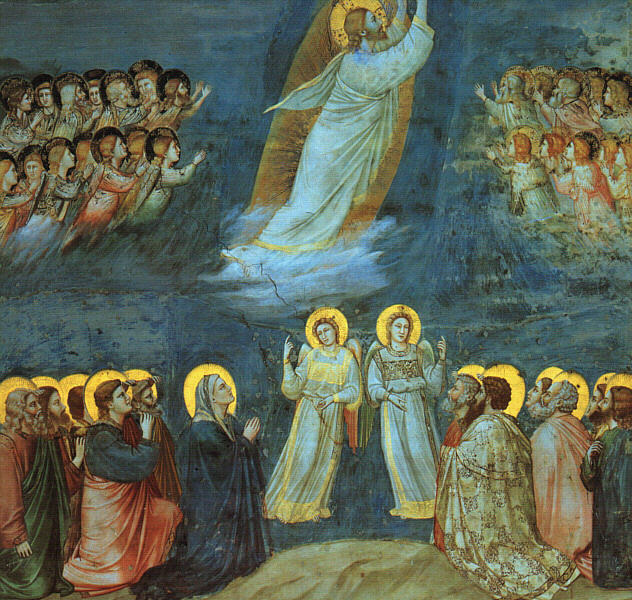
We celebrated the Ascension of Our Lord last Sunday, which we haven’t regularly done here before. As far as I remember, I’d never preached on the proper texts for it, though before my suburban captivity I was reliable in observing it at some church or other. It’s easy to get hung up on visualizing the […]

 Brutally Ordinary Things